Looking for a warm and comforting recipe that's incredibly quick and easy to make? Check out my latest article in The Florentine for Zuppa Ricasoli, a Tuscan soup with butter beans, sausage, pancetta and cabbage. I have to say that I usually run a mile when the words 'cabbage' and 'soup' are used in the same sentence but this really was delicious and healthy too! If you can't find Tuscan sausages, anything herby and garlicy, like a Lincolnshire or Toulouse would be great. A lot of supermarkets now stock sausages with fennel which would work fantastically too. Equally, for the cheesy toasts, there's no point in spending a fortune on Asiago cheese, a good cheddar would be just as good!
Sunday, 27 October 2013
Thursday, 17 October 2013
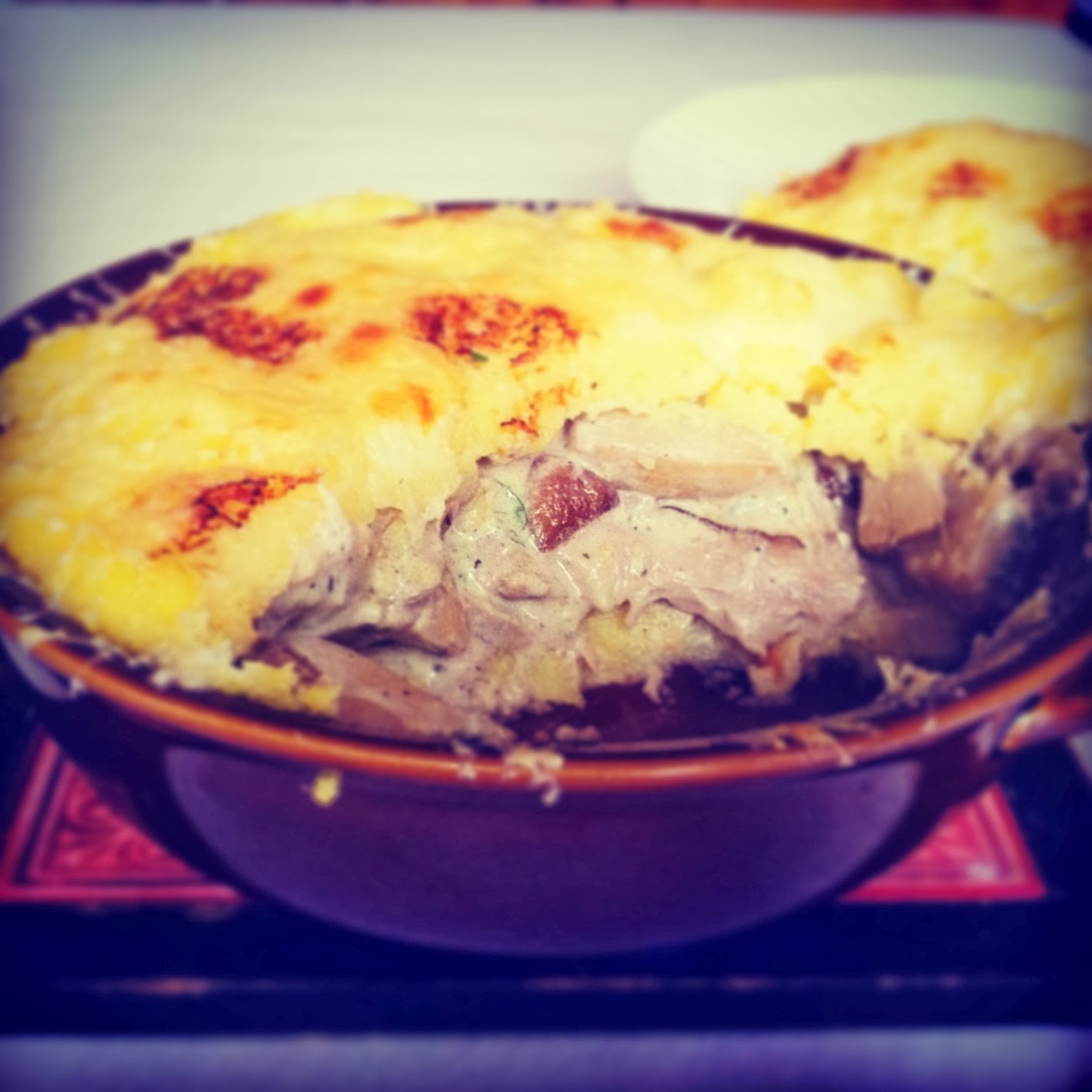
Funghi Porcini e Polenta Gratinata
Earlier this week I was beside myself with excitement after
coming home and finding a basket full of porcini mushrooms on the kitchen
table! A family friend and expert mushroom picker had kindly donated them to us
after I had told him how difficult it was to source porcini in the UK and how,
although I’d often used dried porcini in my cooking, I had never had the
pleasure of being able to cook with fresh ones. After extensively quizzing my boyfriend’s
mother on fresh porcini preparation I decided to experiment with a creamy
porcini and polenta bake and was not disappointed! Again, this is a really simple recipe that delivers big on flavour. For those of you who are unable to source fresh porcini it would also work well using another variety of mushroom, such as chestnut, mixed with some dried porcini for that extra rich flavour.
Serves 4 as a primo
For the polenta
- 350g polenta flour
- 1.5 litres water
- Large teaspoon of salt
For the filling
- 300g porcini mushrooms
- 1 clove finely chopped garlic
- 3 tablespoons olive oil
- 2 teaspoons finely chopped parsley
- 150 ml double cream
- Salt pepper
- Good-quality grated cheese (I used a mix of asiago and parmesan)
To cook the polenta bring the water to the boil in a heavy
based saucepan, add the salt and sprinkle in the polenta flour. Keep stirring
with a wooden spoon and allow to cook for 40-45 minutes. For those of you who
don’t have time for this stage (let’s face it, it’s a bit of a faff really) you can
also use quick-cook or ready-made polenta which you can find in most big
supermarkets.
When your polenta is cooked, pour it onto a large, clean work surface
and spread it out to a 2-3cm thickness and leave to cool. When cold, cut out
the disk
Clean your porcini by scraping them with a knife and wiping
with a clean tea towel. If your mushrooms are really dirty you can give them a
quick rinse under some cold water but be sure to dry them as quickly as possible
as washing the mushrooms will make their flavour less intense. Separate the
mushroom stalks from the tops by gently twisting them, then slice into fairly
chunky pieces.
Heat the olive oil and garlic in a frying pan then add the
mushrooms and let them simmer for about 10-15 minutes. Stir in the cream and parsley
and turn off the heat then season well with salt and pepper.
Place a disk of polenta in the bottom of your greased dish
or ramekin. Add a generous amount of the porcini mix and top with another disk
of polenta. Cover with lots of cheese and grill for about 10 minutes or until
the top is golden and bubbling!
Wednesday, 9 October 2013
Fiori di Zucca Ripieni al Forno
Cooking with courgette flowers is still such a novelty for me since, unless you grow your own, they’re not so easy to come by in the UK. Well, not in Lincolnshire at least! For those of you who have never had the pleasure of eating courgette flowers, I have to say that in terms of flavour you’ve not missed out on much, but what I love about them is that no matter how they're prepared they always look exquisite and are such a versatile receptacle for showcasing great flavour and texture combinations. This summer we grew courgettes in our garden in Pisa and my Italian family's preferred method of preparation was stuffing the flowers with mozzarella and anchovies, then battering and frying them to create the most gorgeous, colourful and crunchy antipasti which brightened up many a mid-week lunchtime!
Having bought some courgette flowers myself this week, I decided to try something new and which didn't involve battering since, unlike my boyfriend's mother, I rarely have the patience required for deep fat frying things on a week day! Instead, I decided to experiment with oven-baking my flowers and after rummaging through the fridge for inspiration, I came up with my delicious and very simple spin on stuffed courgette flowers using a soft Italian cheese called Robiola. Unless you’re living in London, and willing to pay well over the odds, you may struggle to source this particular cheese but anything mild and creamy should do the trick, Philadelphia would probably work equally well! So here they are, my oven-baked courgette flowers...
Serves 6 as a side dish
Remove the yellow stigma from inside the courgette flowers and, if still attached, snap off the stems at the bottom too.
Roughly chop the courgette and Parma ham and pan fry in the olive oil over a medium-low heat until the courgette is soft. Transfer to a blender and blend the courgette, ham, robiola and mozzarella to a smooth paste, adding salt and pepper to taste.
Gently open the flowers and stuff them with a large teaspoon of the robiola puree. A piping bag would be ideal for this step however I used a teaspoon and it worked just fine. Lay the stuffed flowers in a baking dish and cover with a plain béchamel sauce (Delia Smith’s all-in-one recipe is perfect for this) until the flowers are evenly coated.
Sprinkle with parmesan and bake in the oven at 180C for about 20 minutes or until the parmesan is bubbling and golden. I served ours with some very simple grilled chicken and a rocket salad, but feel free to use your imagination!
- Olive oil
- 12 courgette flowers
- 1 medium courgette
- 100g Parma ham
- 200g Robiola or similar
- 1 ball of mozzarella
- 100g parmesan cheese
- 400ml Béchamel sauce (not too thick)
- Salt and pepper
Remove the yellow stigma from inside the courgette flowers and, if still attached, snap off the stems at the bottom too.
Roughly chop the courgette and Parma ham and pan fry in the olive oil over a medium-low heat until the courgette is soft. Transfer to a blender and blend the courgette, ham, robiola and mozzarella to a smooth paste, adding salt and pepper to taste.
Gently open the flowers and stuff them with a large teaspoon of the robiola puree. A piping bag would be ideal for this step however I used a teaspoon and it worked just fine. Lay the stuffed flowers in a baking dish and cover with a plain béchamel sauce (Delia Smith’s all-in-one recipe is perfect for this) until the flowers are evenly coated.
Sprinkle with parmesan and bake in the oven at 180C for about 20 minutes or until the parmesan is bubbling and golden. I served ours with some very simple grilled chicken and a rocket salad, but feel free to use your imagination!
Sunday, 6 October 2013
10 reasons why Italians are so slim
Before moving to Italy, I always thought a big downside of leaving the UK was that I could kiss goodbye to my size 1o figure; with the pizza, the pasta, the wine and daily trips to the gelateria, gaining weight seemed inevitable. During my first month in Italy, I did put on some weight from gorging on all the amazing food on offer, but then something quite unexpected happened, my weight gradually started to go down until it eventually plateaued at about half a stone less than when I arrived! For some time I couldn't work it out but then I started to reflect on the Italian diet. Italy has the second lowest obesity rate in Europe after Romania at just 9.3%, whereas, in the UK, obesity is currently at 23.9%. Yes, there is a lot of wonderful food in Italy, some of it rather carb-heavy to say the least but is it really any worse than what I’d been eating back in the UK? And had my change in lifestyle affected my eating habits? After giving it some thought I came up with 10 reasons why I think Italians manage to eat so well and yet stay so slim, so here they are…
1. They eat at lunch
A lot of Italians, including my boyfriend’s family, eat their main meal at lunchtime meaning that they have all day to burn off the energy. Having a substantial meal early on in the day also reduces the temptation to snack, so come 4 pm I no longer fight to resist having a sneaky biscuit (or 5) with my afternoon tea.
2. They have primo and secondo
The format of primo and secondo means that Italians first eat a small amount of carbohydrates (the primo) and then fill up on meat and vegetables (the secondo), ensuring that their diet is balanced. The pause between courses also gives you more time to register that you’re full meaning that you don’t overdo it and then regret it 10 minutes later when you’re feel like you've eaten the Christmas turkey!
3. They eat less butter
Italians don’t butter their bread nor use butter for cooking anywhere near as often as us Brits. It may seem like a small change but over an extended period of time it could really make a difference. Saying that, I still haven’t quite come to terms with the idea of an un-buttered sandwich!
4. They have less of a sweet tooth
For a country that’s in love with food Italians certainly seem to lose their mojo a little when it comes to desserts. Puddings are rarely served at home and the selection of traditional Italian desserts is extremely limited when compared to Italy’s extensive savoury repertoire. Tiramisu and panna cotta are great but when that’s about all that’s on offer, it gets easier to say no after a while!
5. They eat less processed foods
Probably the most fundamental point of all is that Italians make most of their food from scratch. The ready-meal aisle of the supermarket quite simply doesn't exist in Italy; after all, what could be quicker to cook up for dinner than a bowl of spaghetti? I showed the Dolmio microwavable pasta advert to my Italian friends and they thought it was a joke!
6. They have a healthier attitude to food
Fad dieting is nowhere near as big in Italy as it is in the UK. Rather than binging and dieting, a constant and moderate diet is favoured by most. When I suggested cutting out carbs to my boyfriend his reaction was, ‘but a carb-free diet makes people grumpy’. I guess he had a point…!
7. They don't drink as much
Another hugely influential factor has got to be the booze. Italians generally don’t drink outside of meals and, when they do, they only have one or two. There is still quite a stigma attached to heavy drinking in Italy, especially for women, so whilst for Brits having a few too many and staggering home at the end of the night might be funny, for Italians it’s probably an embarrassing story that they’d rather keep to themselves. The size of a glass of wine in Italy is also much smaller, to the extent that my Mum once thought the glass our waiter had poured her was just a taster!
8. They have a warmer climate
Cold weather undoubtedly plays a part in increasing appetite so when the summer in Italy lasts for so much longer and the temperature is so much hotter it’s no wonder they don’t eat as much. As lovely and refreshing as a rocket salad is, I’m not sure it’s ever going to cut it for dinner during a British winter!
9. They have to get their bodies out in public
On a related topic, the fact that, for 3 months a year, Italians regularly go to the beach with friends and family is a huge motivation to keep an eye on their weight. In the UK we can quite happily stuff our faces knowing that, with the help of some loose clothing, our friends and neighbours will never see the effects on our body (thank goodness)!
10. The bella figura
Italians place a huge amount of importance on appearance and are a nation that celebrates beauty. With fashion brands such as Gucci, Prada and Dolce and Gabanna at the heart of Italian style, maintaining a slim figure is all part of the Italian bella figura. For us Brits, appearance, although important, does not define a person in the same way as it does for Italians. So although of course it’s nice to be slim, maybe we should celebrate the fact that in the UK, it’s OK to indulge in that third glass of wine, to order the jumbo fish and chips or to have an extra biscuit with your cup of tea… after all, you only live once!
Monday, 30 September 2013
La Bersagliera
This weekend I went with a
group of friends to my very favourite pizzeria. Bearing in mind that, living in
Pisa, I have over 120 pizzerias right on my doorstep, almost every time I go
for pizza with friends we take the 20km drive through a series of tiny villages
to reach the pizzeria La Bersagliera on the outskirts of Lucca. The
surroundings are not in any way spectacular, it is set right on the edge of the
SS12, surrounded by residential buildings. Similarly, the interior leaves a lot
to be desired with plain white walls, a series of camping-style, long, wooden tables
and benches and a vast array of ornaments and trinkets that make you feel as
though you are an intruder in an old lady’s retirement flat. When it comes to
the service, things aren't much better, stories of the 'like it or lump it' attitude of the
dinnerlady-style waitress have become local legends. We warn the two
newcomers in our group to keep their heads down and not to ask too many
questions! When eating at the Bersagliera you can expect to be crammed in like
a sardine, presented with a menu that consists only of pizza, one variety of
wine and one variety of beer and then to wait between 40 – 90 minutes for your
food to arrive. Yet the thing that keeps us and so many others coming back time
and time again is, of course, the incredible pizza.
The first thing that makes
the pizzas so great is the toppings. The Bersagliera specialises in sourcing
Calabrian ingredients, which are not so easily found in other pizzerias, such as Calabrian sausage, sopressata, sorriso (a blend of chilies), rosa marina (tiny
fish in a spicy sauce) and the best olives I've ever tasted in my life. Then,
there is the pizza base itself which is beautifully fresh, salty and the
perfect compromise between the thin Tuscan base and the deep pizza from Naples.
The best part of all is the generosity of the portions, the pizzas are easily
twice the size of a standard pizza and are covered with an abundance of toppings.
Most people don’t even come close to finishing a full pizza in one sitting but,
for me, being able to take the rest home and eat it the next day is one of the biggest draws!
| Edoardo was very happy with his calzone! |
| Pizza Tarantella con mascarpone |
In tribute to my new pizza topping combo, I decided to make some n’duja (pronounced un-doo-ya) and mascarpone pasta for lunch today. Super simple, super quick and super tasty!
Maccheroni con n’duja e mascarpone
Serves 4
- 400g maccheroni rigate
- 1tbsp n’duja sausage
- 1tbsp mascarpone
- Parsley for serving
Cook the pasta in
boiling salted water until it is al dente then drain, keeping to one side some of the pasta water. Stir the n’duja and mascarpone into the pasta, adding a little of the water until you get a smooth, creamy sauce. Garnish with a sprinkle of chopped parsley. It’s a
simple as that! Buon appetito!
You can visit La Bersagliera in via Pisana, 2136, Lucca, Italy
Thursday, 26 September 2013
Gnocchi alla Sorrentina
Last
week my friend Valeria and I decided to organise a dinner party inspired by some homemade ingredients that she had brought back from her hometown of Bono
in Sardinia. Her father had cured some prosciutto and sausage which we served as antipasti, along with some Sardinian cheese and typical Sardinian bread called
Pane Carasau. For the primo we decided on Gnocchi alla Sorrentina, a dish from Sorrento, near
Naples, in an attempt use up the last of the season’s tomatoes. Of course you
could cheat a little and buy your gnocchi ready-made but I wasn’t about to pass
up the opportunity for a master class in making fresh gnocchi so we decided to
start completely from scratch.
There
are in fact many different varieties of gnocchi including gnocchi di farina
(made with bread and flour), gnocchi di polenta (with polenta flour), gnocchi
di castagne (with chestnut flour) and many types of gnocchi with added
ingredients such as spinach, pumpkin or cheese. The recipe for gnocchi alla
Sorrentina, however, calls for the classic potato gnocchi, which was perfect for my first gnocchi-making experience! Since we had two coeliac guests for dinner, we replaced the wheat
flour with a gluten-free mix but for my non-coeliac readers, here is the
method for the classic potato gnocchi:
Note: Classic potato gnocchi should be made without egg but most Italians add at least one to ensure that the mixture binds together well for a smooth result.
Serves 4
For the gnocchi:
- 100g flour
- 400g potatoes (a floury variety)
- 1 egg
- Salt
Wash the potatoes and put them into salted boiling water
with the skins on. Leave them to boil for around 30 minutes or until you can
easily pierce them with a knife, then drain and leave them to cool down a little.
Once sufficiently cooled, you can then begin to peel the skin
off the potato. Cooking the potatoes with the skins on makes them incredibly
easy to peel and also gives them a richer, earthier flavour. When all the skin
has been removed, pass the warm potato through a potato ricer or mash
thoroughly. Do not use a blender as the potato will become heavy and gelatinous.
Tip the mashed potato onto a floured surface, make a hole in
the middle and fill it with the flour, egg and around a teaspoon of salt. Gently
incorporate all the ingredients until you create a ball of dough. Do not
over-work the mix as the gnocchi need to be fluffy and light.
Divide the dough into 3 pieces and roll them out into long
cylinders about 2cm wide, re-flouring the surface as required. Cut the
cylinders into 2cm long pieces using a sharp, floured knife.
You can then shape each gnocc0 (gnocco is the singular form of gnocchi, one gnocco, two gnocchi) by lightly rolling it
with your thumb against a ridged surface, slightly twisting your thumb at the
last minute to create a small fold in the back. We used a
gnocchi board to create this effect but you can also get great results by just rolling the gnocchi
across the prongs of a fork. Continue this process, placing the finished
gnocchi on a tea towel until you have used all of the dough. If you don't have the time or patience for shaping your gnocchi don't worry, a rustic rectangular or even round gnocco is perfectly acceptable, you can even just squash them a little bit with a fork!
To
cook the gnocchi simply drop them into salted, boiling water and drain once
they begin to float to the top, this should only take about 2-3 minutes so make sure you keep an eye on it! If making the gnocchi alla Sorrentina, make sure you have prepared your sauce (see below) before cooking the gnocchi!
For the Sorrentina sauce:
- 500g fresh tomato sauce
- Basil to garnish
- 250g buffalo mozzarella (cut into 2cm cubes)
- 100g grated parmesan
Before cooking the gnocchi, pre-heat your oven to 180C. Take
an oven-proof dish and line the base and edges with a little fresh tomato sauce
and place 1/3 of the mozzarella in the bottom. If you can’t find buffalo
mozzarella, normal is fine. Lining your dish with tomato sauce will ensure that
the gnocchi won’t stick to the sides.
Cook your gnocchi as above. Note: To save time, do not salt the water until it is
fully boiling as salted water takes longer to come to the boil.
Return the drained gnocchi to the pan and mix with the remaining
tomato sauce, another 1/3 of the mozzarella and half of the parmesan. Pour the
tomato-coated gnocchi into the baking dish, sprinkle over the remaining
parmesan and mozzarella and bake until the cheese is bubbling and golden brown
on top.
Garnish with basil leaves and eat it while it’s hot! As you can see, it certainly went down well with our dinner guests!
Gluten-free gnocchi
100g gluten-free flour (we used Schar)
400g potatoes
2 eggs (plus one extra yolk if your mixture doesn’t seem to
be coming together)
Salt
Wash the potatoes and put them into salted boiling water
with the skins on. Leave them to boil for around 30 minutes or until you can
easily pierce them with a knife then drain and leave them to cool down a
little. Once sufficiently cooled, you can then begin to peel the
skin off the potato. Cooking the potatoes with the skins on makes them
incredibly easy to peel and also gives them a richer, earthier flavour. When
all the skin has been removed, pass the warm potato through a potato ricer or
mash thoroughly. Do not use a blender or the potato will become heavy and
gelatinous.
Tip the mashed potato onto a floured surface, make a hole in
the middle and fill it with the flour, egg and around a teaspoon of salt.
Gently incorporate all the ingredients until you create a ball of dough. As the
flour is gluten-free, you will need to knead for a little longer than when using
normal flour in order to create some elasticity to the dough.
Divide the dough into 3 pieces and roll them out into long
cylinders about 2cm wide, re-flouring the surface as required. Cut the
cylinders into 2cm long pieces using a sharp, floured knife.
You can then shape each gnocc0 (gnocco is the singular form of gnocchi, one gnocco, two gnocchi) by lightly rolling it with your thumb against a ridged surface, slightly twisting your thumb at the last minute to create a small fold in the back. We used a gnocchi board to create this effect but you can also get great results by just rolling the gnocchi across the prongs of a fork. Continue this process, placing the finished gnocchi on a tea towel until you've used all of the dough. If you don't have the time or patience for shaping your gnocchi don't worry, a rustic rectangular or even round gnocco is perfectly acceptable, you can even just squash them a little bit with a fork!
You can then shape each gnocc0 (gnocco is the singular form of gnocchi, one gnocco, two gnocchi) by lightly rolling it with your thumb against a ridged surface, slightly twisting your thumb at the last minute to create a small fold in the back. We used a gnocchi board to create this effect but you can also get great results by just rolling the gnocchi across the prongs of a fork. Continue this process, placing the finished gnocchi on a tea towel until you've used all of the dough.
To cook the gnocchi simply drop them into salted, boiling water and drain once they begin to float to the top, this should only take about 2-3 minutes so make sure you keep an eye on it! If making the Gnocchi alla Sorrentina, make sure you have prepared your sauce before cooking the gnocchi!
Subscribe to:
Posts (Atom)